Should I Pay Points to Lower My Mortgage Rate?
Should you pay discount points to lower your mortgage rate? Learn how mortgage points work, how to calculate your break-even point, and when paying points may or may not make financial sense.
 Jason Herbert 11 min read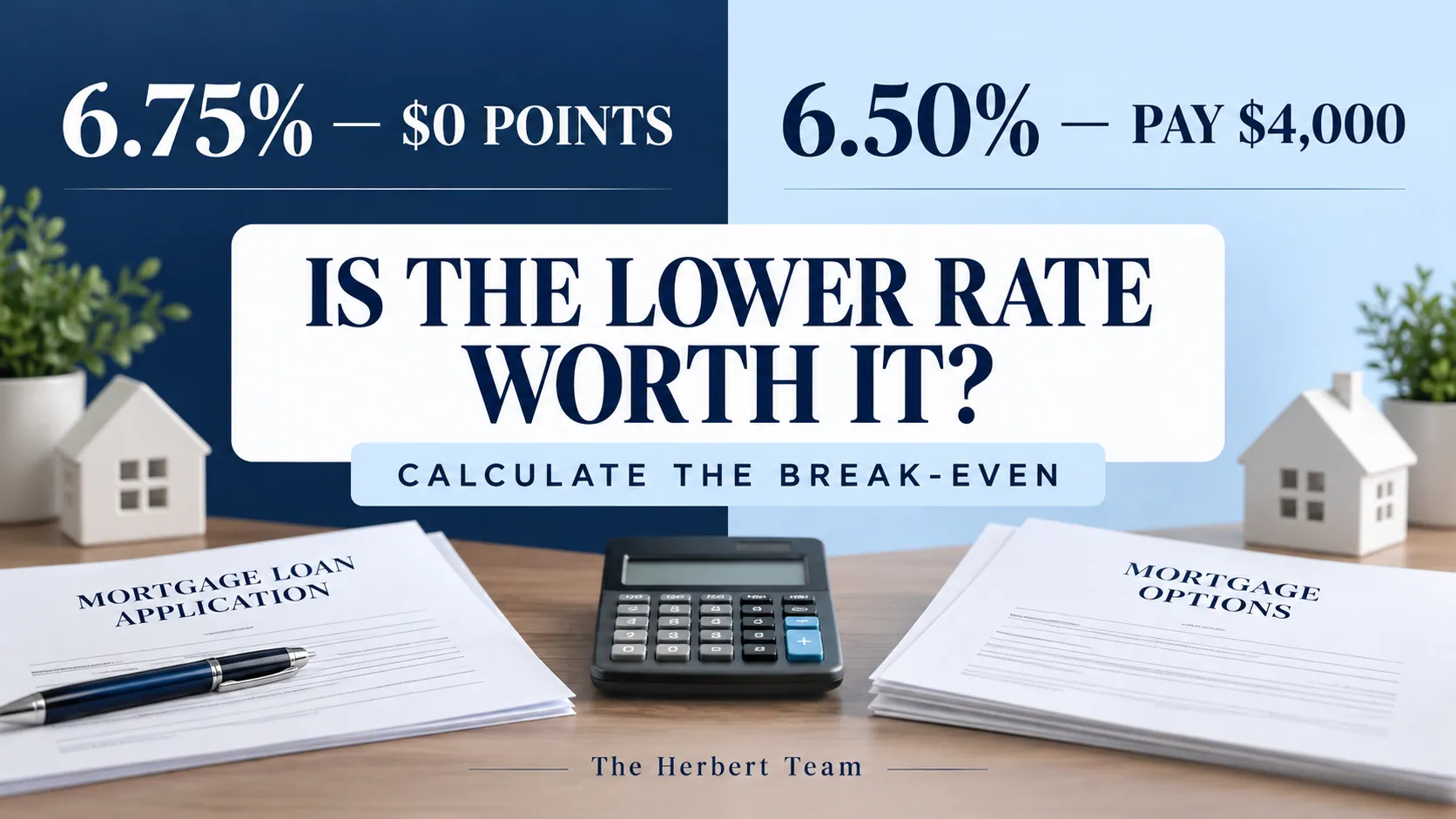
If you’re getting mortgage quotes, there’s a good chance you’ll eventually see something like this:
6.75% with no points
or
6.50% with one point
The lower rate immediately looks better.
But there’s another number you need to look at:
What does it cost to get that lower rate?
This is where I think buyers sometimes make a mistake.
They focus so heavily on getting the lowest possible interest rate that they never stop to ask whether paying for that rate actually saves them money.
Sometimes it does.
Sometimes it absolutely does not.
The right question isn’t:
“Should I pay points?”
It’s:
“How long will it take me to recover the cost of those points, and am I likely to keep this mortgage long enough for that strategy to pay off?”
That’s what we’re going to break down.
What Are Mortgage Discount Points?
Discount points are an upfront cost you can pay in exchange for a lower mortgage interest rate.
One point equals 1% of the loan amount.
So if your mortgage is:
$300,000
One point would cost:
$3,000
On a:
$400,000 mortgage
One point would cost:
$4,000
And on a:
$500,000 mortgage
One point would cost:
$5,000
The point is generally paid as part of your closing costs.
In exchange, you receive a lower interest rate than you would have received on the same loan without paying those points.
But there’s something really important to understand.
Does One Point Always Lower My Rate by 0.25%?
No.
This is one of the biggest misconceptions about mortgage points.
There is no universal rule that says paying one point always reduces your mortgage rate by 0.25%.
The actual rate reduction you receive can change based on:
- Mortgage market conditions
- Loan program
- Loan amount
- Credit profile
- Property type
- Occupancy
- How the lender is pricing rates that day
Sometimes one point might produce a meaningful improvement in rate.
Other times the improvement may be much smaller.
That’s why I don’t want a buyer asking simply:
“How much is one point?”
I want to know:
“What rate do I get without the point, what rate do I get with the point, and what is the actual monthly savings?”
Now we can make a financial decision.
The Break-Even Calculation Is What Really Matters
This is the number I want buyers to understand.
Your break-even point tells you approximately how long it takes the monthly savings from the lower interest rate to recover the upfront cost you paid for the points.
The basic calculation is:
Cost of the points ÷ Monthly payment savings = Break-even period
Let’s make that real.
Example: Paying One Point on a $400,000 Mortgage
For illustration only, let’s say you’re comparing these two options on a $400,000 30-year fixed mortgage:
Option A
6.75% interest rate
No discount points
Principal and interest would be approximately:
$2,594 per month
Option B
6.50% interest rate
One discount point
One point on a $400,000 loan would cost:
$4,000
Principal and interest at 6.50% would be approximately:
$2,528 per month
So you’re paying:
$4,000 upfront
to save approximately:
$66 per month
Now let’s calculate the break-even.
$4,000 ÷ $66 is roughly:
61 months
That’s a little over five years.
So in this hypothetical example, you need to keep that mortgage for roughly five years before the monthly principal-and-interest savings recover the $4,000 you paid upfront.
That doesn’t automatically mean the point is good or bad.
It gives us the information we need to decide.
What If You Sell the House Before the Break-Even Point?
Suppose your break-even is five years.
But you think there’s a good chance you’ll sell the house in three years.
You may spend $4,000 upfront without keeping the mortgage long enough to recover the entire cost through monthly savings.
In that situation, paying points may not make sense.
The same issue applies if you refinance before reaching the break-even point.
Once you refinance the original mortgage, you no longer receive the monthly savings associated with the rate you bought down on that loan.
So your expected time in the loan matters—not just your expected time in the house.
What If You Plan to Keep the Mortgage for a Long Time?
Now flip the scenario.
Suppose your break-even point is five years and you expect to keep this mortgage for 10, 15, or even 30 years.
Once you get beyond the break-even point, the lower monthly payment continues.
That’s where paying points may become much more attractive.
But even then, I still want to compare that strategy against what else you could do with the cash.
If you’re spending $4,000 on points, that’s $4,000 that is no longer available for:
- Emergency savings
- Moving expenses
- Home improvements
- Additional down payment
- Paying down other debt
- Other financial priorities
Mortgage decisions don’t happen in a vacuum.
Should I Pay Points Just to Get the Lowest Rate?
Not necessarily.
This is where rate shopping can get misleading.
Imagine two buyers talking.
One says:
“I got 6.50%.”
The other says:
“I got 6.75%.”
It sounds like the first buyer clearly got the better deal.
But what if the first buyer paid $8,000 to get that rate while the second buyer paid no points?
Now we need much more information before we decide who got the better mortgage.
Rate without cost means very little.
When comparing mortgage offers, I want you comparing:
Rate + points + lender costs + monthly payment
—not the interest rate by itself.
Can the Seller Pay My Discount Points?
Potentially.
Depending on the mortgage program, transaction, and applicable seller-contribution limits, seller concessions may potentially be used toward eligible discount points or other permitted closing costs.
This ties directly into the seller-credit strategy we’ve discussed before.
Suppose the seller is willing to give you a $10,000 concession.
We might compare:
Option 1: Use the seller credit toward eligible closing costs.
Option 2: Use some of it toward discount points to permanently lower the mortgage rate.
Option 3: Use an eligible combination of the two.
That’s a much better conversation than automatically saying:
“Use all $10,000 to buy the rate down.”
We need to determine where that money creates the most value for you.
Seller contributions are subject to program limits and other requirements, so the structure needs to be reviewed before the contract is finalized.
What About a Lender Credit?
A lender credit essentially moves the strategy in the opposite direction.
With discount points:
You pay more upfront to receive a lower interest rate.
With a lender credit:
You generally accept a higher interest rate in exchange for the lender contributing money toward closing costs.
Neither is automatically better.
Imagine someone who expects to keep the mortgage for a very long time and has plenty of cash available.
Paying points may be worth considering.
Now imagine a buyer who wants to preserve every reasonable dollar of savings after closing and may refinance or move within several years.
A lender-credit structure may deserve consideration.
The strategy should match the borrower.
Cash After Closing Still Matters
This connects directly to one of the biggest themes I talk about with buyers.
I don’t only care whether you have enough money to close.
I care how much money you have after closing.
Suppose you have $25,000 remaining after your down payment and normal closing costs.
Then someone offers you the opportunity to spend another $5,000 buying the interest rate down.
Maybe that’s a fantastic investment.
But what if spending the $5,000 leaves your emergency fund too small?
Now saving $70 or $80 per month may not be worth giving up the liquidity.
Your mortgage rate matters.
So does your savings account.
Paying Points When Rates May Change
This is another issue worth discussing.
Mortgage rates move.
If you pay thousands of dollars to permanently reduce your rate and then refinance a year or two later because market rates decline substantially, you may never reach your original break-even point.
That doesn’t mean you should assume rates will fall.
Nobody knows exactly where rates will be in the future.
And I would never build a mortgage strategy around a guaranteed future refinance.
But if the cost of the points requires seven years to break even, the possibility that your mortgage could change before then needs to be part of the conversation.
This is why I want you looking at several time horizons.
What happens if you keep the mortgage:
Three years?
Five years?
Seven years?
Ten years?
That gives us a much better picture.
A Very Short Break-Even Can Be Different
Now imagine a different scenario.
Suppose paying $2,500 in points saves you $85 per month.
Your break-even would be about:
29 months
That’s a little under two and a half years.
If you’re confident you’re likely to keep the mortgage substantially longer than that, the strategy may look much more attractive.
This is exactly why I don’t have a blanket rule that says:
“Always pay points.”
or
“Never pay points.”
Show me the cost.
Show me the payment savings.
Then show me the break-even.
Don’t Confuse Discount Points With Every Fee Called a “Point”
The word points can sometimes create confusion.
You may hear people use it generically to describe fees calculated as a percentage of a loan amount.
But when we’re talking about discount points, I specifically mean money paid in exchange for a lower interest rate.
When reviewing your Loan Estimate, make sure you understand exactly what you’re paying and what benefit you’re receiving.
Don’t accept:
“You’re paying one point.”
Ask:
“What rate would I receive without paying it?”
That gives you something meaningful to compare.
The Three Mortgage Options I Like to Compare
When points are part of the conversation, I often prefer showing buyers several options side by side.
Option 1: Lower Rate With Points
More money upfront.
Lower monthly payment.
Option 2: Zero-Point Option
Less money upfront than the discounted-rate option.
Higher payment than Option 1.
Option 3: Lender Credit
Higher interest rate.
Potentially lower cash required for eligible closing costs.
Then we compare:
- Cash to close
- Monthly principal and interest
- Total estimated housing payment
- Break-even period
- Cash remaining after closing
- How long you expect to keep the mortgage
Now you can actually choose a strategy instead of simply choosing the lowest rate on the page.
What If I Have Seller Credits I Need to Use?
This can change the conversation.
Suppose you’ve negotiated seller concessions and already have your other eligible closing costs covered.
Depending on your mortgage program and applicable limits, using eligible seller funds toward discount points may be worth evaluating.
Why?
Because you may be able to permanently reduce your interest rate without personally writing the same size check for the points.
But we still need to evaluate the economics.
I don’t want to spend seller money inefficiently simply because it’s available.
We should determine where every dollar of the concession creates the greatest benefit.
Should First-Time Home Buyers Pay Points?
Being a first-time buyer doesn’t automatically make points good or bad.
But first-time buyers often have an additional consideration:
Cash reserves.
If paying points requires you to drain most of your remaining savings, I may be much less excited about the strategy.
Your first few months as a homeowner tend to create expenses you didn’t have as a renter.
Keeping adequate reserves can be incredibly valuable.
On the other hand, if seller concessions are covering the points or you already have strong reserves and expect to keep the loan for a long time, the calculation may look completely different.
Again:
Run the numbers.
So, Should You Pay Points to Lower Your Mortgage Rate?
Maybe.
Here’s what I would want to know first:
How much do the points cost?
Exactly how much do they lower the interest rate?
How much does that save you each month?
What is the break-even period?
How long do you realistically expect to keep this mortgage?
How much cash will you have left after closing?
Are seller credits available that could change the strategy?
Once we know those answers, deciding whether to pay points becomes much easier.
Don’t buy a rate simply because it looks good.
And don’t reject points just because they cost money upfront.
Calculate the return on the money you’re spending.
That’s the mortgage strategy.
If you’re preparing to buy your first home, my First-Time Home Buyer’s Playbook walks through the entire process—from preparing your finances and getting preapproved through the offer, mortgage process, and closing.
And when you’re ready to run your actual financing scenarios, I’ll show you the options side by side so you can see exactly what you’re paying, what you’re saving, and when you break even.
Frequently Asked Questions
What is one mortgage point?
One discount point equals 1% of the mortgage loan amount. For example, one point on a $400,000 mortgage costs $4,000.
How much does one point lower a mortgage rate?
There is no fixed amount. The interest-rate reduction associated with a discount point varies based on the lender, loan program, borrower profile, and mortgage market.
How do I calculate the break-even point on mortgage points?
Divide the upfront cost of the discount points by the monthly payment savings created by the lower rate. For example, if points cost $4,000 and save approximately $66 per month, the simple break-even is roughly 61 months.
Are mortgage points worth paying?
They may be if the monthly savings are meaningful and you expect to keep the mortgage beyond the break-even period. They may be less attractive if you expect to sell or refinance before reaching break-even or if paying the points significantly reduces your emergency savings.
Can a seller pay mortgage discount points?
Potentially. Depending on the loan program, transaction, and applicable contribution limits, eligible seller concessions may sometimes be used toward discount points or other allowable buyer costs.
Are discount points the same as a down payment?
No. A down payment reduces the amount you borrow. Discount points are an upfront cost paid to obtain a lower mortgage interest rate.
What is a lender credit?
A lender credit generally works in the opposite direction of discount points. The borrower accepts a higher interest rate and receives a lender credit that can offset eligible closing costs.
Should I pay points if I plan to refinance later?
The expected timing matters. If you refinance before reaching the break-even period, you may not recover the full upfront cost of the points through monthly savings. Because future rates are uncertain, the decision should be based on multiple possible timeframes rather than assuming a future refinance will occur.
Mortgage examples are for educational and illustrative purposes only and are not a rate quote or offer to lend. Principal-and-interest examples do not include taxes, homeowners insurance, mortgage insurance, HOA dues, or other housing expenses. Mortgage rates, discount-point pricing, seller contributions, lender credits, eligibility, costs, and loan terms vary by borrower, property, loan program, lender, and market conditions.