Should You Buy Points? Run These Three Numbers First
Discount points explained with real math — break-even, the tax angle, and the four situations where buying down your rate is usually the wrong move.
 Jason Herbert 5 min read
“Should I buy points?” is one of the most common questions I get, and the honest answer is that it depends on three numbers most people never calculate.
Let me give you those numbers, and then the four situations where the answer is almost always no.
What a point actually is
A discount point is prepaid interest. You pay money at closing, and in exchange the lender gives you a lower interest rate for the life of the loan.
One point equals 1% of your loan amount. On a $400,000 loan, one point is $4,000. What that buys varies with market conditions, but a reasonable working assumption is that one point reduces your rate by roughly 0.25%.
That is the entire mechanism. You are buying a lower payment with cash up front, which makes this a straightforward investment question: how long does it take to earn back what you spent?
Number one: your break-even
Take the cost of the points and divide it by your monthly savings.
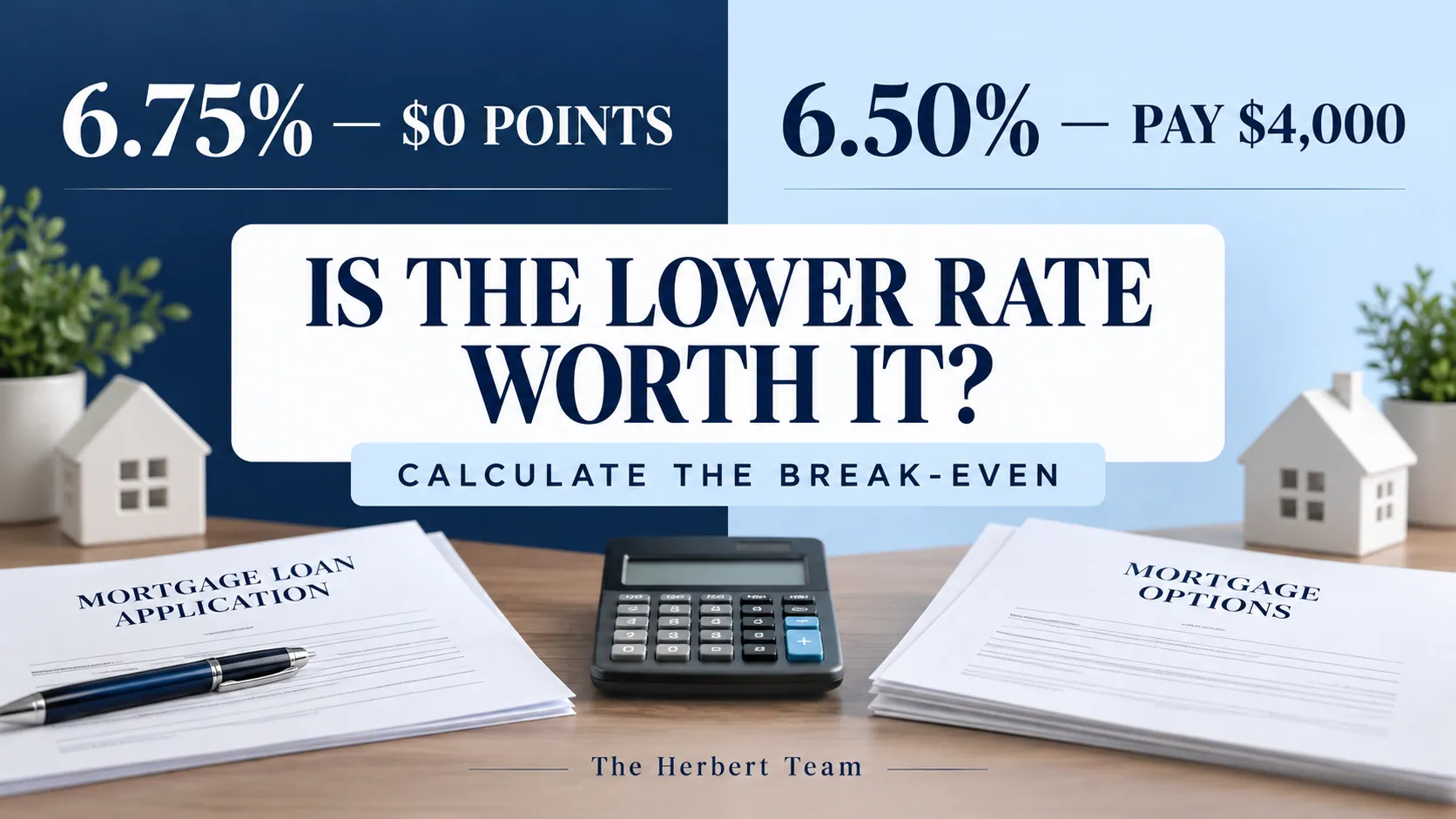
On a $400,000 loan at 6.75% over 30 years, principal and interest run about $2,594. Buying one point for $4,000 to reach 6.5% brings that to about $2,528 — a savings of $66 a month.
$4,000 divided by $66 is roughly 61 months. A little over five years.
That is your break-even. Keep the loan longer than five years and buying the point made you money. Sell or refinance sooner and you paid $4,000 for a partial benefit.
Number two: how long you will actually keep this loan
This is where most people get it wrong, because they answer with how long they plan to own the house. Those are different questions.
The relevant span is how long you keep this specific loan. If you refinance in year three, the loan ends even though you still own the home. Historically, the average mortgage is paid off or refinanced in well under ten years.
So ask yourself honestly: is this a starter home you will outgrow in four years? Are rates elevated enough that a refinance in the next two or three years is plausible? Are you likely to relocate for work? Every one of those shortens the life of the loan and undermines the case for points.
If you are buying a home you intend to stay in for fifteen years and current rates are already historically low, the calculus flips entirely.
Number three: what else that money could do
Points are not free money. That $4,000 has alternative uses, and some of them are better.
It could be your emergency fund. A buyer who spends their last liquid dollars on points and closes with $800 in the bank has made a fragile decision. The first HVAC failure turns into credit card debt at 22%. Liquidity has real value that does not show up in a break-even calculation.
It could reduce your loan amount. Putting the $4,000 toward principal instead lowers your balance, which lowers your payment slightly and may improve your loan-to-value. If it moves you across a pricing tier or eliminates mortgage insurance, that beats the point almost every time. This is a comparison worth running explicitly.
It could pay down higher-interest debt. If you are carrying a credit card at 22%, using $4,000 to buy a mortgage point earning roughly 20% annualized is worse than simply paying the card. Not by a lot, but the card also improves your credit utilization and your monthly cash flow.
It could stay invested. Depending on your situation and risk tolerance, the expected return on that money elsewhere may exceed what the point returns.
Four situations where I usually say no
You are buying a starter home. If the plan is three to five years and then move up, you will likely not reach break-even. Keep the cash.
Rates are elevated relative to recent history. If a refinance in the next few years is a realistic possibility, prepaying interest on a loan you intend to replace is buying something you will not finish using.
Points would drain your reserves. New homeowners have expenses that renters do not. A fund that covers three to six months of payments is worth more than 0.25% on your rate.
The seller is already paying your closing costs. If seller concessions are on the table, that money is often better spent on a temporary buydown or on closing costs than on permanent points — particularly when you may refinance.
When points genuinely make sense
You are staying put for a long time. Fifteen years in a forever home makes a five-year break-even an easy decision.
Someone else is paying for them. Seller-paid or builder-paid points are the best version of this. A builder motivated to move standing inventory will often fund a permanent buydown worth far more than an equivalent price reduction. That is free money in a way that self-funded points never are.
You have strong cash reserves and want the lowest payment. If liquidity is not a constraint and cash flow is your priority, buying down the rate is a legitimate way to spend money for a permanent monthly benefit.
The buydown crosses a qualifying threshold. Occasionally a lower payment is what brings your debt-to-income ratio into range. In that case the point is not an investment decision at all — it is what makes the loan possible.
A note on temporary buydowns
You may hear about a 2-1 buydown, where the rate is reduced by two percentage points in year one and one point in year two before settling at the note rate. These are typically funded by a seller or builder, and they can be genuinely useful if you expect income growth or a refinance opportunity.
Just be clear about what you are agreeing to: your payment increases in year two and again in year three. Make sure you can afford the year-three payment, because that is the one you are actually committing to. I underwrite my clients to the final payment for exactly this reason.
The bottom line
Buying points is neither smart nor foolish in the abstract. It is an investment with a calculable return, and the only way to know whether it fits is to run your specific numbers.
I do this analysis for every client as a matter of course, and it takes about five minutes. Sometimes the answer is buy two points. Sometimes it is keep your cash. Either way you make the decision with the actual math in front of you, which is the only way it should ever be made.