What Happens to a HELOC During Divorce? Who Pays, Who Can Borrow, and What Happens When You Refinance?
Learn who pays a HELOC during divorce, who can still borrow, and how payoff or subordination affects refinancing, with Texas and California caveats.
 Jason Herbert 10 min read
A divorce does not automatically close a home equity line of credit, divide its balance, or release a borrower. Your plan needs to address payments, access to additional borrowing, and how the HELOC lien will be handled when you refinance or sell.
If you are deciding who keeps the house, start with both loan statements. The first mortgage may be the largest payment, but an open HELOC deserves its own place in the conversation.
For example, imagine a couple who agrees that one spouse will keep the home and refinance within six months. Their spreadsheet includes the first mortgage and a buyout payment. It leaves out a HELOC that still has a balance and available credit.
Before that housing plan is ready, several questions remain: Who makes the next payment? Can anyone borrow more? Will the line be paid off or stay in place? What happens if the refinance cannot close?
A HELOC is a separate borrowing arrangement
A HELOC is revolving credit secured by your home. It often sits behind a first mortgage, although a HELOC can also be a first lien. During its draw period, borrowing may remain available under the agreement. Afterward, repayment terms apply. Variable rates and the transition into repayment can change the monthly cost. Review the actual agreement rather than assuming today’s payment will last. CFPB: HELOC basics
The credit limit, outstanding balance, and payoff amount are different numbers. A $100,000 limit does not mean you owe $100,000. A statement balance also may not include all interest and charges needed to satisfy the account on a future closing date.
Who pays the HELOC during divorce?
There are two layers: the arrangement between spouses and the obligation to the creditor. A settlement can assign payments to one spouse without changing the lender’s contract. A borrower may remain responsible until the creditor grants a contractual release or the debt is resolved through an appropriate payoff or refinance. A deed transfer alone does not accomplish that release. State law and the signed documents also matter. CFPB: debt after divorce
The same principle applies to the first mortgage. See Does a Divorce Decree Remove Your Ex From the Mortgage?
Have your attorney address who pays, when payments are due, how statements are shared, and what happens if a payment is missed. Ask the lender how each person’s role appears in its records. Someone who consented to a property lien is not necessarily a borrower on the note.
Keep records of payments and new advances. If the parties disagree about a draw, its purpose, or its treatment in the property division, the attorney handles that legal dispute. The mortgage review needs accurate balances and obligations to evaluate financing.
Who can still borrow from the HELOC?
Do not assume that moving out, filing for divorce, or signing a settlement disables account access. Ask the HELOC lender to identify everyone permitted to request advances, the current draw status, and its procedure for restricting or ending future advances. The account terms and applicable law control; access is not identical on every line.
Also ask your attorney what any temporary orders allow. The ability to submit a draw online does not establish legal permission to use the money.
If you are concerned about additional borrowing, contact the lender and your attorney promptly. Ask whether a restriction or closure can be requested, who must authorize it, when it becomes effective, and how pending transactions are treated. Obtain written confirmation. Do not rely on a verbal assurance or simply destroying a checkbook.
Federal rules limit when a creditor may suspend advances or reduce a line. Divorce itself is not a blanket authorization for any lender action. A significant decline in the home’s value, or a material change in financial circumstances that leads the lender to reasonably believe the borrower cannot repay, may permit restrictions under specified conditions. CFPB: Regulation Z, §1026.40(f)
Freezing, closing, paying off, and releasing are different steps
| Step | What to verify with the lender and closing professional |
|---|---|
| Restricting future advances | Which transactions stop, when the restriction starts, and whether anyone can restore access |
| Closing the credit line | Whether further borrowing ends and how the remaining balance must be repaid |
| Paying the balance | The dated payoff amount, delivery instructions, and any account-termination requirements |
| Releasing a borrower | Written creditor confirmation of whose contractual obligation ends |
| Releasing the lien | The required release document and recording or other completion process |
Treat this table as a list of questions, not a description of a particular bank’s policy. A zero balance does not, by itself, tell you that the revolving account has been terminated or that a lien release has been completed.
What happens to the HELOC when you refinance?
For a HELOC behind the first mortgage, there are two common planning paths: pay it off as part of an eligible transaction, or seek approval to leave it in place.
If the HELOC stays in place
The new first-mortgage lender must address lien priority. Under Fannie Mae’s conventional guidance, subordinate financing left in place generally must be resubordinated to the new first mortgage, unless state law keeps it in its existing subordinate position. Ask about the HELOC lender’s process, documents, fees, and timing early. Do not assume consent will be granted. Keeping the line also requires a separate answer about any departing borrower’s continuing obligation. Fannie Mae: subordinate financing
If the HELOC is paid off
How the borrowed money was used can affect the new loan’s classification. Fannie Mae distinguishes payoff of a purchase-money second lien from payoff of a non-purchase-money second. Its table treats payoff of a non-purchase-money second as a cash-out refinance, even without extra cash delivered to the borrower. Have the lender review the transaction and any applicable exceptions. These are Fannie Mae rules, not universal rules for every loan program. Fannie Mae: refinance classification
Fannie Mae separately treats certain co-owner buyouts, including those resulting from a divorce settlement, as limited cash-out refinances, with conditions including at least 12 months of joint ownership and a written agreement. That provision is not a reason to assume an existing HELOC payoff is automatically eligible. Give the lender the complete proposed structure and draw history before promising a particular refinance type. Fannie Mae: limited cash-out and owner buyouts
Freddie Mac, FHA, VA, USDA, jumbo, portfolio, and HELOC lenders have their own requirements. Approval, pricing, equity limits, and documentation depend on the selected program and lender.
The unused credit limit can matter, too
For Fannie Mae loans with a retained HELOC, the home equity combined loan-to-value (HCLTV) calculation includes the full line amount, whether or not funds have been drawn. A documented permanent modification may affect that calculation. Paying down a balance and reducing a credit limit are different actions. Fannie Mae: HCLTV ratios
That is why a feasibility review should include the credit limit as well as the current balance. Ask the lender what changes, if any, would be needed for the proposed transaction before asking the HELOC lender to alter the account.
An example: equity is not the same as available financing
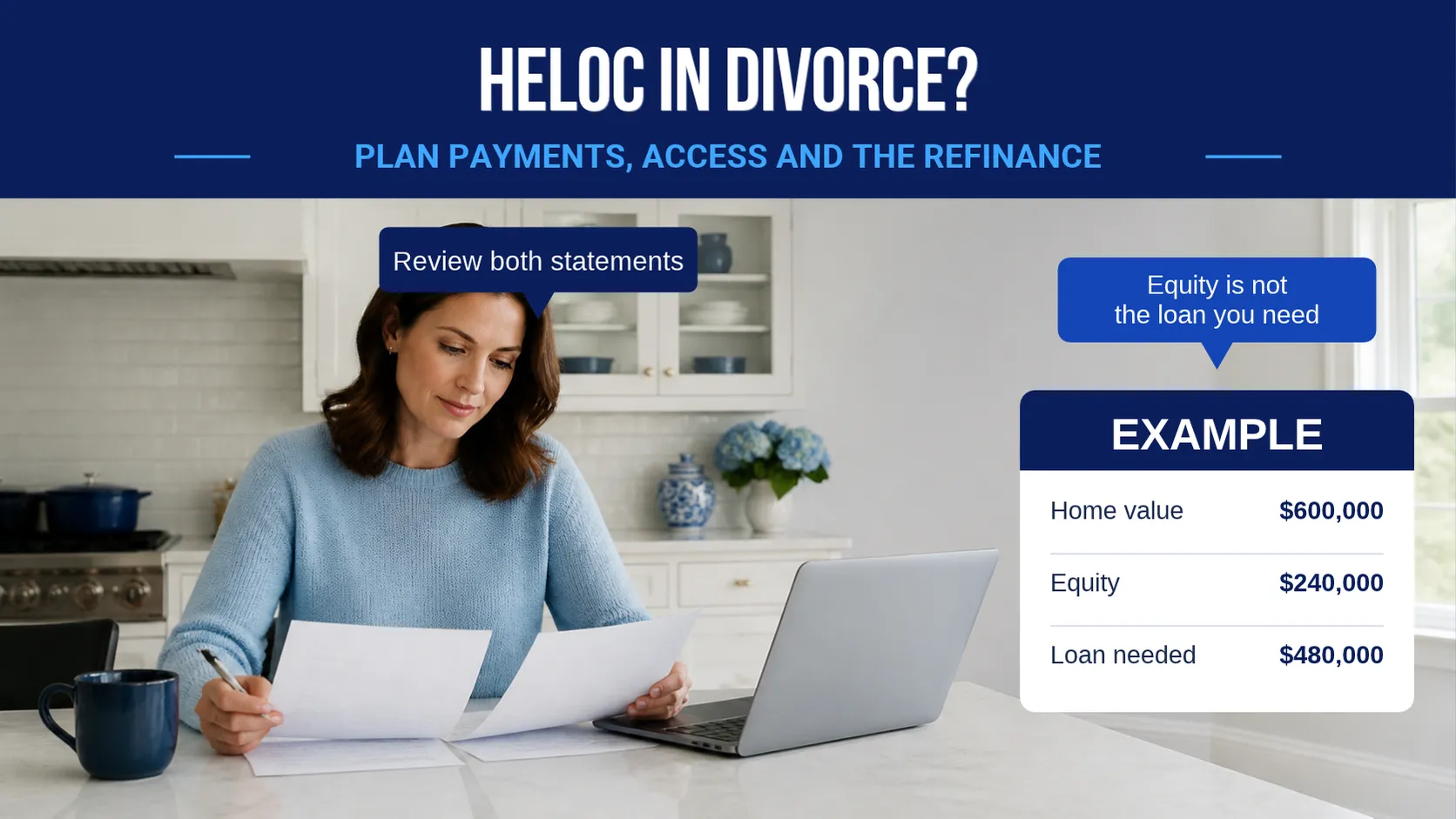
Suppose the home is valued at $600,000, the first mortgage balance is $300,000, and the HELOC balance is $60,000. Before other liens, costs, adjustments, and legal allocations, the simple equity calculation is:
$600,000 − $300,000 − $60,000 = $240,000.
If the agreement calls for an equal division of that illustrative equity, one half is $120,000. Your attorney must determine the actual division; equal division is only an assumption in this example.
If the retaining spouse proposes a new loan that pays the first mortgage, pays the HELOC, and funds that $120,000 buyout, the starting financing need is $480,000 before costs and other adjustments. That is 80% of the assumed property value. It is arithmetic, not an approval or a statement that a program permits the transaction.
A later $20,000 HELOC draw would change the balances and could change the settlement accounting and financing plan. Ask your attorney which dates and balances control, how new draws are handled, and how to avoid counting the same debt or buyout twice.
Can a new HELOC fund the buyout and preserve the first mortgage rate?
Possibly, if the legal arrangement, property, borrower, and available product qualify. Compare the combined payments and total borrowing cost, including any variable-rate exposure. Keeping a lower first-mortgage rate does not automatically make the overall plan affordable.
Borrowing against the home carries risk: if you fall behind or cannot repay on schedule, you could lose the home. Qualification also depends on factors such as income, credit, and property value. CFPB: HELOC basics
A new HELOC does not itself release a spouse from an existing first mortgage. Review that obligation separately. Confirm product availability directly; do not assume The Herbert Team or any particular lender offers every HELOC structure.
Texas caveat: homestead equity rules need a separate review
Texas homestead equity lending has specific requirements. The official state interpretations require consent from each owner and each owner’s spouse for a Section 50(a)(6) lien, and impose an 80% combined-debt limit when the equity loan is made. Consent to the lien and signing the note are distinct roles. Ask the lender and title professional to classify the existing lien and proposed refinance, including whether Section 50(f) requirements apply. A divorce label does not settle the loan classification. Texas home equity interpretations: Chapter 153, §§153.2–153.3
Have your Texas attorney review any temporary orders or local standing orders before changing debt, title, or access to funds.
California caveat: court restrictions can affect borrowing
California’s family-law summons contains standard restrictions on transferring or encumbering property without the other party’s written consent or a court order, subject to stated exceptions. It also requires notice of proposed extraordinary expenditures. Before drawing, opening, closing, or refinancing a HELOC during a California divorce, have your attorney review the orders effective in your case. Do not assume an available account balance makes a transaction permissible. California Judicial Council: FL-110, page 2
Your attorney also determines community or separate debt treatment, reimbursement claims, and the legal allocation. A mortgage professional evaluates financing feasibility.
Bring these items to a Mortgage Feasibility Review
- Current first-mortgage and HELOC statements, plus account agreements if available.
- HELOC credit limit, transaction history, draw-period end date, and repayment terms.
- Names and roles on each loan and the current property title information.
- Proposed buyout amount, property value assumptions, and refinance deadline.
- Relevant proposed or signed agreements and temporary orders, shared securely.
- Income, assets, other debts, and the proposed monthly housing budget.
Ask for a comparison of payoff, retained-lien, and sale scenarios where appropriate, with unresolved lender and legal questions clearly identified. If the home will be sold, ask the closing professional to obtain current payoff instructions for all liens and confirm how the HELOC will be terminated and its lien released.
Before committing to a housing deadline, request a Mortgage Feasibility Review with The Herbert Team. Bring the HELOC statement along with the first mortgage so the review starts with the full picture. A feasibility review is not a loan approval or guarantee of closing.
The Herbert Team’s Divorce and the Mortgage Guide covers additional mortgage questions that can arise before, during, and after divorce. You can also visit our Divorce Mortgage Planning page.
Frequently asked questions
Does divorce automatically close a HELOC?
No. Confirm the account’s status and any requested changes directly with the HELOC lender. The legal agreement and lender account process must be coordinated.
Can my spouse keep borrowing after we separate?
Ask the lender who currently has advance authority and ask your attorney what restrictions apply. Do not assume either permission or a block based only on separation.
Can I remove my ex’s name without refinancing?
Ask whether the lender offers a contractual release or another approved option for this particular account. Get its requirements and decision in writing; availability is not guaranteed.
Does a freeze erase the balance or stop payments?
Do not treat a borrowing restriction as debt forgiveness. Continue to follow the payment obligation unless the lender confirms an approved change. Ask exactly what the restriction does.
Must a HELOC be paid off when I refinance the first mortgage?
Not in every transaction. Ask the new lender and HELOC lender whether an eligible retained-lien structure is available and what documentation and lien-priority steps it requires.
Is a divorce HELOC payoff always rate-and-term?
No. The lender must review the program, use of proceeds, existing lien, and transaction structure. Do not select a loan classification based solely on the divorce decree.
What if the HELOC balance is zero?
Supply the statement and credit limit anyway. Ask whether the account remains open and whether termination or lien-release steps are needed for the proposed transaction.
Should we address the HELOC before signing the settlement?
Yes. Give your attorney and mortgage professional time to identify account, financing, and timing questions before the housing plan depends on a particular outcome.
Jason Herbert | The Herbert Team | NMLS #633039
Educational information only; not legal, tax, or individualized financial advice. Consult your divorce attorney about debt allocation, court orders, title, and settlement terms. Financing is subject to application, credit and property review, underwriting, lender and program requirements, and approval. Guidelines and product availability may change. No payoff structure, borrower release, subordination, refinance, or closing date is guaranteed.